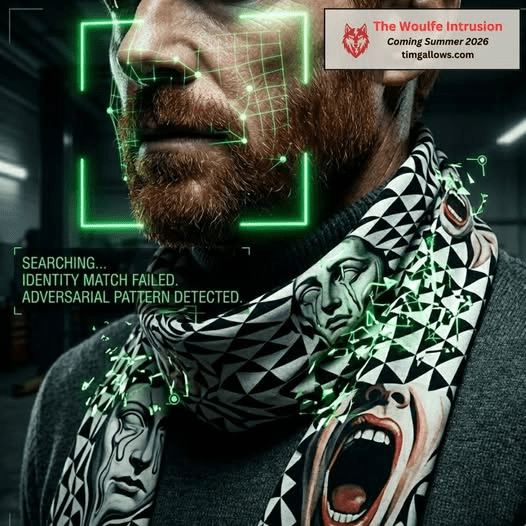
Art isn’t just for museums. Sometimes, it’s the only way to hide from the algorithm.
I woke two hours before sunset. I planned to scout the café before tomorrow, but now I was wanted by Interpol. Tr4cer sent me the footage from Baumann’s estate. The camera angle in the garage was clean, catching me crouched behind the Mercedes, firing outside. Color, high-resolution, full face. Enough for any facial recognition system.
I sifted through my luggage and pulled out something that might help.
Tyler was an artist, the kind I might have been if I hadn’t joined the military. While my talent focused on sketching buildings, all lines and angles and arches, he could create just about anything. One evening before a mission, we talked about how face detection was making my life harder. When I returned home two weeks later, he handed me a gift.
A custom scarf.
Black and white triangles warped across the fabric, layered with melting Dali-like faces and obscene screaming mouths in Bacon’s style. The distorted geometry threw off facial recognition. We tested first with our phones, then I ran it in the field. It worked, confusing keypoint tracking systems long enough to matter.
Technology moves fast. It might not confuse cameras anymore, or for as long, but I packed it anyway. And in the artsy De Pijp neighborhood, it wouldn’t draw attention unless someone stopped me to ask where to buy one.
I opened the zip-locked bag I’d stored the scarf in since Tyler died. A faint whiff of our old fabric softener hit me. By the time I had it wrapped around my gray turtleneck, I needed a tissue.